Amp Head(s)
Mesa Boogie Mark III Long Head ×2
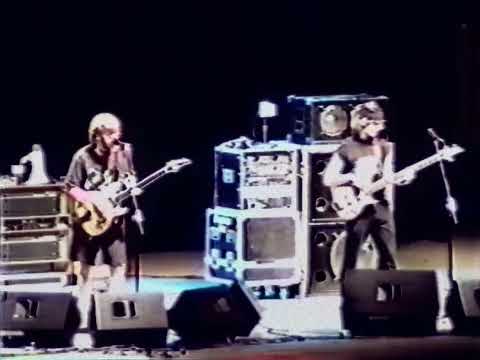
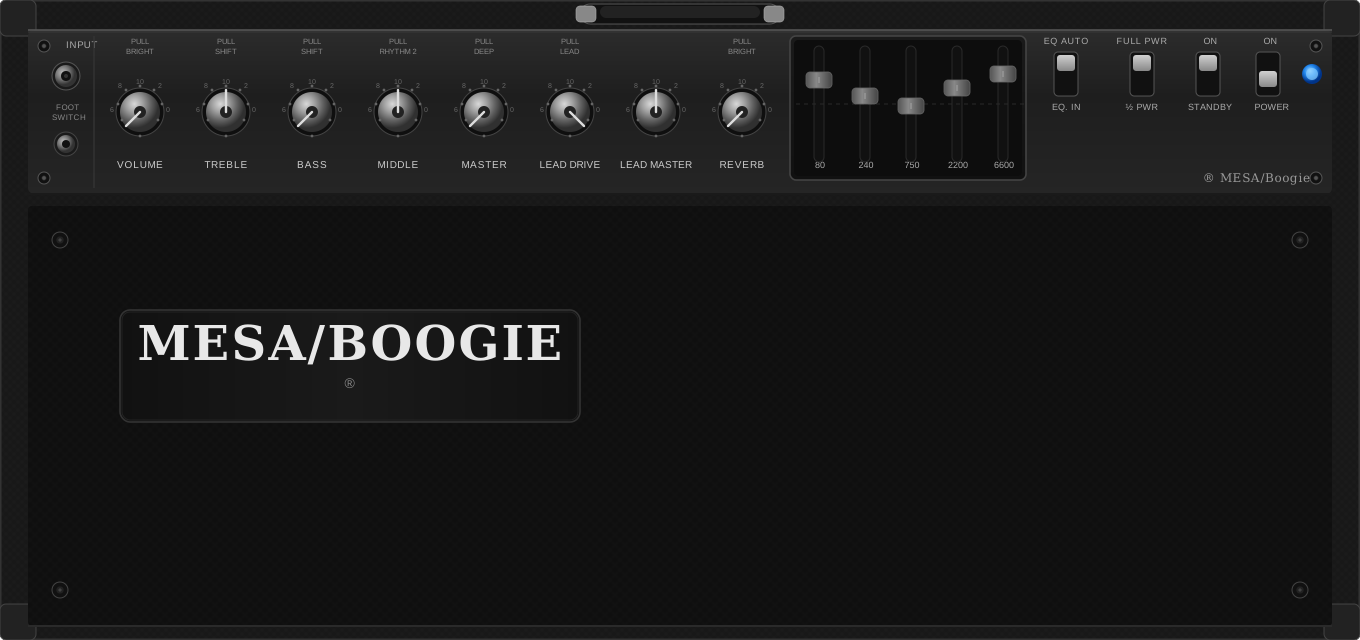
Trey's primary amp throughout this era, purchased around 1985 or '86. The Long Head variant is distinguished from standard Mark IIIs by two visual tells: a fourth front-panel switch (the half-power switch, dropping from 100W to 60W by disabling two of the four 6L6 power tubes) and an eighth front-panel knob for reverb (moved to the rear on non-Long-Head units). A three-channel amp: Rhythm (clean, Blackface Fender-influenced), Rhythm 2 (light crunch), and Lead (high gain). Whether Trey's units are the Simul-Class variant (75W/15W switchable) or standard 100W heads has not been confirmed. A second Mark III Long Head was added around November 1992 — the first time a rack enclosure was part of the rig. The Lead, Rhythm 1, and Rhythm 2 channels were all footswitched via two dedicated pedals on his pedalboard during this era. Whether Trey used the amp's onboard reverb is unknown.
Speaker Cabinets ×2
Custom Languedoc 2×12 ×2
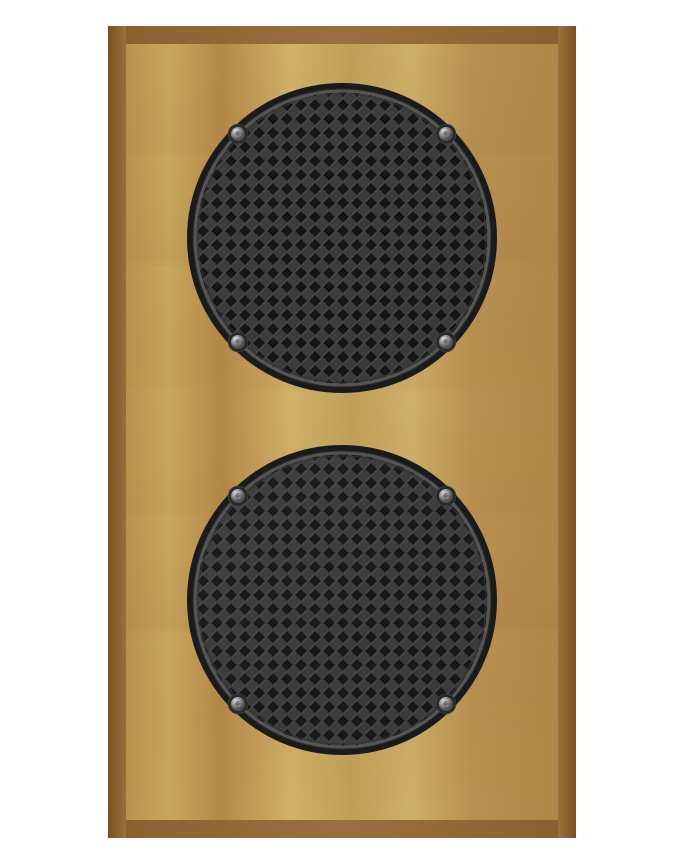
Trey had Paul Languedoc build him two 2×12 cabinets — trading guitar lessons in exchange for the builds. One was loaded with Electro-Voice speakers, the other with Celestion Vintage 30s. Trey used one or both cabinets depending on the show.
Cabinet wiring scheme
Both cabinets were loaded with two 8-ohm speakers wired in series, giving each cabinet a total impedance of 16 ohms. Paul wired each cabinet with two speaker input jacks, with one jack wired in parallel to the other. This clever scheme gave Trey flexible impedance options: a single cabinet could be driven safely from the Mesa Boogie's 8-ohm output jack — the two 16-ohm jacks in parallel presenting an 8-ohm load to the amp. When using both cabinets, Trey would chain one into the other, combining the two 16-ohm cabinets in parallel for a total load of 8 ohms, still safe to run from the same 8-ohm output.
The sold & recreated EV cabinet
Trey sold the Electro-Voice-loaded cabinet sometime around 1990–1991 while in California. He later regretted the decision and had Paul build a recreation of the original. The 11/19/92 show appears to be the debut of this new replicated cabinet — footage suggests both were on stage that night — though this has not been definitively confirmed.
Dual heads & first rack — November 1992
Around November 1992, Trey added a second Mesa Boogie Mark III head to the rig and housed both heads together in a proper rack enclosure for the first time. Prior to Fall 1992, there was no rack in the setup — the single Mesa Boogie head had sat loose on or near the cabinets throughout the early years. The dual-head configuration, driving the two Languedoc 2×12 cabinets, remained the amp foundation through the end of this era and into the early Bradshaw years.
Who's The MarMar? — Full Technical Reference
Construction, specs, complete pickup configuration history (original three-pickup config, single-coil removal, ebony cover, 2015 Fare Thee Well reinstall), the "Sonic Maximizer" story, photo dating guide, and era-by-era usage are all documented on the dedicated deep dive page.
Who's The MarMar? — Gear Deep Dive →
-
Early Phish — pre-1988
Before the Languedoc hollowbody was ready, Trey played a Time branded strat-style guitar — a 22-fret instrument with three single-coil pickups, similar in layout to a standard Fender Stratocaster. This was his primary guitar in the earliest days of the band before transitioning to the first Languedoc build. The first confirmed performance with this guitar is April 6, 1985, at Hunt's in Burlington, VT.
-
Debut — ~Early 1988 (open question)
Trey transitioned to the first hollowbody guitar Paul Languedoc ever built — a maple top / padauk body instrument that would define the early Phish sound. The exact debut date is an open research question. In Under The Scales podcast Episode 12, Trey mentions an inscription on the inside of the guitar by Paul noting November 1987 — but this most likely reflects when Paul was finishing the body of the guitar. Trey's live debut is believed to be in early 1988, though this has not been definitively confirmed.
-
Construction
Maple top with padauk body — a combination that contributed to the guitar's warm, resonant character distinct from typical solidbody instruments of the era.
Hollowbody
Maple Top
Padauk Body
Paul Languedoc Build #1
-
Builder & origin
Built by Paul Languedoc to Trey's specification ahead of a European backpacking trip — a compact, travel-friendly instrument purpose-built for the road. Paul was working at Time Guitars at the time, which accounts for the Time Guitars logo on the headstock and the Time Inc. branding on the pickguard.
-
Construction
Bubinga body, 22 frets. One single humbucker (brand and model unknown), chrome volume and tone knobs, and an ornate black pickguard printed with Time Inc. The headstock bears the Time Guitars logo.
-
First known performance — May 7, 1985
Trey's first (and possibly only) documented stage appearance with this guitar was at Hunt's in Burlington, VT — Phish's 23rd known show. Reportedly around 250 people attended.
-
Acquisition timing — open question
It is not confirmed whether Trey already had the mini-travel guitar before the May 7 show, or whether this was its debut the moment it arrived. Both remain plausible given the context of it being built for an upcoming trip.
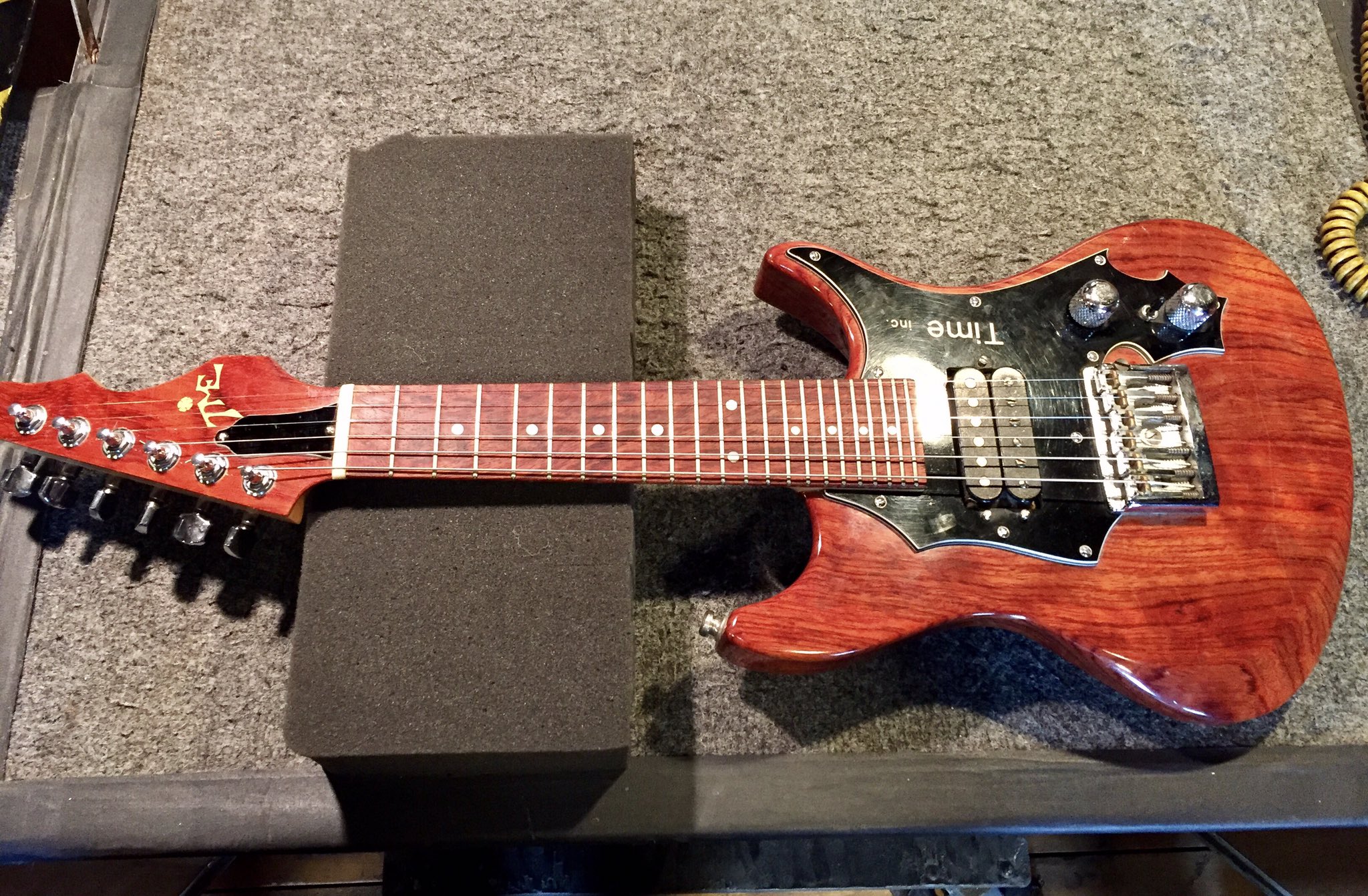
Time Mini-Travel Guitar · Bubinga body, 22-fret · "Time inc." pickguard ↗
New documentation — Time Mini-Travel Guitar
This instrument is newly documented and distinct from the Time strat-style guitar Trey was playing as his primary at this time. The May 7, 1985 show at Hunt's is the only confirmed stage appearance — whether Trey played it again is unknown. Open questions remain on the current whereabouts of the guitar and the full extent of its live use. If you have recordings, further photos, or other primary source material, please reach out.
-
Built
1991 — constructed by Paul Languedoc as a dedicated backup instrument for Trey.
-
Construction
Spruce top with a maple body. Featured a unique back panel designed for easy access to the guitar's internal electronics.
-
Headstock
The first known use of what is now the trademarked Languedoc headstock design.
-
Headstock Inlay
A pearl inlay of adult Marley the dog chasing a cat, with a conversation bubble reading "I'm the mar mar" — a companion piece to the MarMar's puppy inlay.
-
Stage use
Trey rarely played this guitar in the early 1990s — it served primarily as a backup and was not a regular presence in live shows. The only known Phish show where the Spruce guitar was played for the entire set is March 30, 1993 at the Hilton Ballroom. Phish.com's show notes record that Trey warmed up his spare guitar during soundcheck and played it all night.
Languedoc headstock — first appearance
The Spruce backup guitar holds a notable place in Languedoc history as the first instrument to feature the headstock design that Paul would later trademark. What began as a functional build for a spare has that distinction quietly built into its DNA.
March 30, 1993 — Hilton Ballroom
The only known show where the Spruce guitar was played for the entire night. Phish.com's notes record:
"Trey warmed up his spare guitar (which he played all night) during soundcheck." Source:
phish.com
Hollowbody
Spruce Top
Maple Body
Paul Languedoc Build #2
First Languedoc Headstock
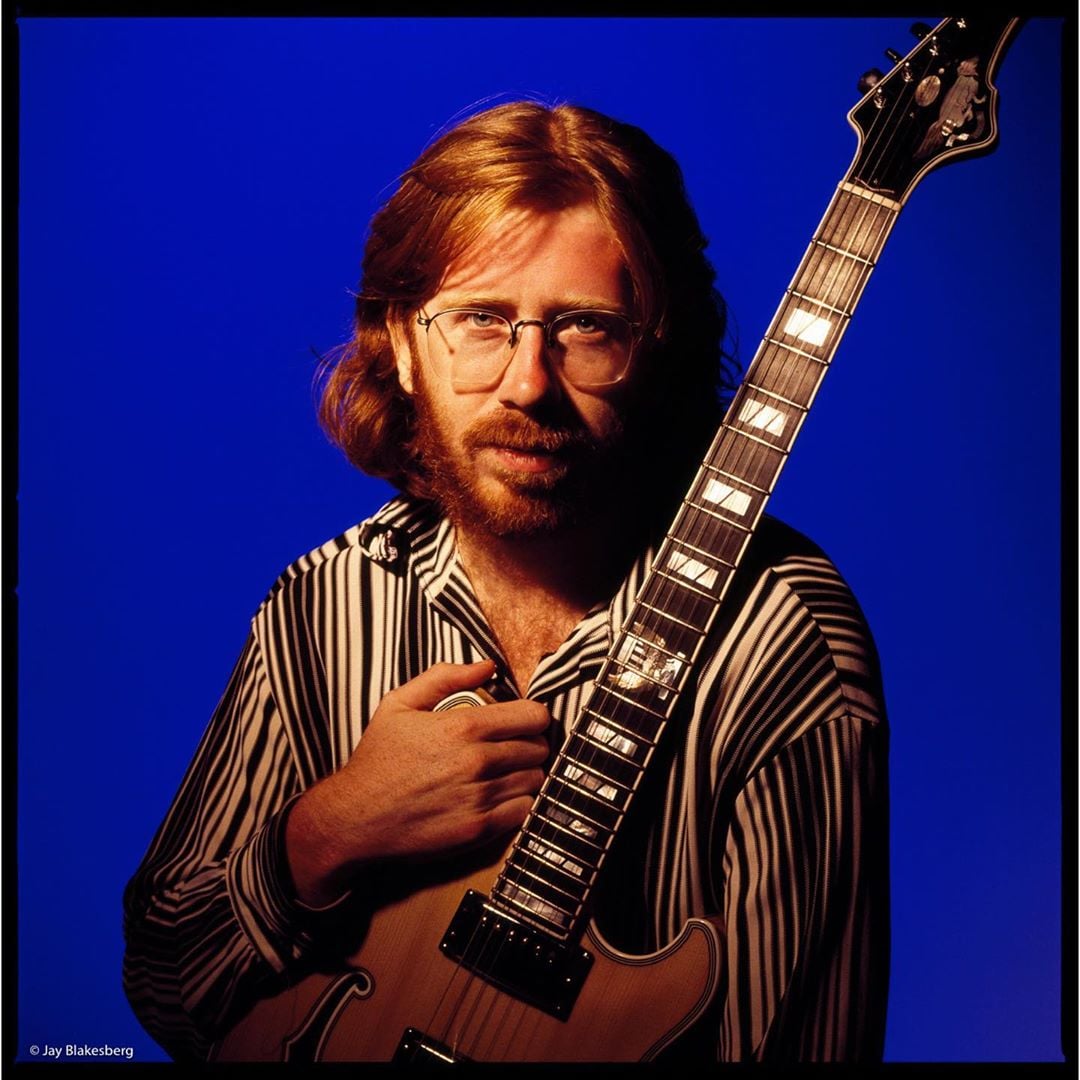
Trey with the Spruce Backup Guitar © Jay Blakesberg ↗
-
Spring–Summer 1993
Trey began regularly picking up an acoustic guitar mid-show for specific songs. The most consistent pattern: The Horse was frequently performed with Trey on acoustic, as was the opening passage of My Friend, My Friend. These acoustic spots appear across dozens of shows on the 1993 tours.
-
Feb 20, 1993
Roxy Theatre, Atlanta — The Horse featured Trey on acoustic guitar. One of the earliest confirmed 1993 instances.
-
Feb 23, 1993
The Edge Night Club, Orlando — the beginning of My Friend, My Friend featured Trey on acoustic guitar.
-
Aug 13, 1993
Murat Theatre, Indianapolis — Trey teased the Würm portion from Starship Trooper on acoustic guitar after Fluffhead.
-
Aug 28, 1993
Greek Theatre, Berkeley — Ginseng Sullivan was performed acoustic. One of the first confirmed acoustic performances of that song.
The Horse / My Friend pattern — 1993
Throughout the Spring and Summer 1993 tours, Trey's mid-show acoustic guitar appearances became a recurring feature. The Horse in particular was performed with Trey on acoustic at a significant number of shows — it was essentially an expected part of the song's live presentation during this period.
Instrument identification — probable Languedoc acoustic
Video evidence from this era suggests the acoustic guitar Trey used for these mid-show appearances was built by Paul Languedoc — the same luthier responsible for his primary hollow-body electric. This has not been independently confirmed; the identification is based on visual analysis of available footage and should be treated as probable rather than certain.
Overdrive
Ibanez Tube Screamer
Trey ran two Tube Screamers — a mix of the TS9 and TS10 variants — for layered overdrive options and always-on tonal shaping.
Compression
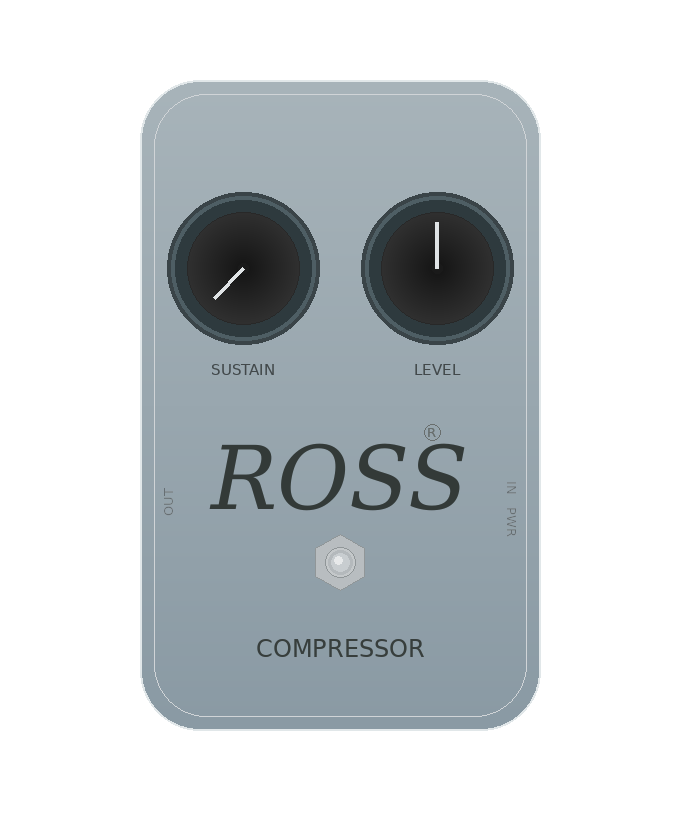
Ross Compressor
The Ross was always on and always in the chain throughout the entire 1.0 era — set once and never touched mid-show. It provided the sustain and pick-attack control that defined Trey's clean tone from the earliest shows through the hiatus.
Reverb / Delay
Alesis Microverb
Placed in the effects loop of the Mesa Boogie. Primarily used on its Reverse setting for a subtle slapback character. Occasionally switched to a large hall reverb for spacey passages.
Volume
Ernie Ball Volume Pedal
Used for swells and overall level control throughout sets.
Switching
2× Channel Switchers
Two dedicated footswitch pedals on the board for switching between the Mesa Boogie Mark III's Lead, Rhythm 1, and Rhythm 2 channels.
Performance Accessory
Megaphone — model unknown
Trey incorporated a megaphone into performances of Fee — held up to a vocal microphone to impart the characteristic filtered, horn-processed vocal effect the song calls for. At least one documented performance predates 10/1/90, placing megaphone use among Phish's earliest documented live arrangements. The megaphone was formally a fixture of the regular rig from 11/19/92 onward. The exact model used in this era is not confirmed; later photo evidence from 1994 and video evidence from 1996 identifies the unit as a Fanon MV-10S.
Signal Chain
Guitar
Languedoc
Hollowbody
→
→
→
Volume
Ernie Ball
Vol. Pedal
→
→
→
Cabinets ×2
Languedoc
2×12 ×2
⤷ Dashed border = effects loop insertion · Channel switching pedals omitted for clarity
Signature moment
The Alesis Microverb's Reverse setting — placed in the amp's effects loop — was responsible for a distinctive slapback-like ambience that colors countless early Phish recordings. For the sprawling, spacey section of You Enjoy Myself, Trey would occasionally engage a large hall reverb preset for a more cavernous wash.
This was the simplest rig Trey ever played — a tight, purposeful setup built around pure tone rather than elaborate processing. No MIDI switching, no harmonizers. Just a Languedoc guitar, a Mesa Boogie, a handful of pedals, and a pair of hand-built cabinets. A second Mesa Boogie head and a proper rack enclosure arrived around November 1992, but the signal chain itself remained essentially unchanged through the end of this era.
The combination of the Ross compressor, dual Tube Screamers, and the warm resonance of the first Languedoc hollowbody created a voice that is immediately recognizable across hundreds of early Phish shows. The Microverb's reverse setting added just enough space without ever cluttering the sound.
This era's tone can be heard throughout the early Phish tape trading circuit — the Vermont basement recordings, the early New England club shows, and the growing run of northeast college circuit performances that built Phish's reputation through the early 1990s.
Pure Tone Era
Mesa Boogie
Languedoc Guitar
Tube Screamer
Ross Compressor
Alesis Microverb
Ernie Ball
Three essential LivePhish releases spanning the era — the earliest officially released soundboard from 1989, a landmark Fall '92 tour opener recorded as Rift was being completed, and the just-released New Year's Eve 1993 Worcester show that closed out the pure-tone era.
Aug 26, 1989
Townshend Family Park — Live Phish Vol. 09
Townshend Family Park, Townshend, VT
The earliest officially released Phish soundboard — a three-set outdoor show in Vermont. The MarMar guitar and single Mesa Boogie head at the heart of everything. Fluffhead, Harry Hood, Divided Sky, YEM, and David Bowie all in one night.
Stream or download →
Nov 19, 1992
St. Michael's College — Fall Tour Opener
Ross Arena, St. Michael's College, Colchester, VT
The opening show of the Fall '92 tour, recorded just as Rift was being finished. Debut of Axilla. Gordon Stone on pedal steel for Llama and Poor Heart. The dual Mesa Boogie setup newly in place — one of the first shows with both heads on stage.
Stream or download →
Dec 31, 1993
New Year's Eve 1993 — Worcester
Worcester Centrum, Worcester, MA
The last New Year's Eve show of the pure-tone era — the aquarium stage set, Peaches en Regalia in memory of Frank Zappa, and Tom Marshall guesting on Antelope. Notably, this release features a rare multitrack mix that lets you hear the MarMar, Mesa Boogie Mark III, and dual Languedoc 2×12 cabinet setup in full detail.
Stream or download →
Research needed
The following items represent open questions for this era — areas where documentation is incomplete or evidence is not yet confirmed.
-
MarMar — live debut date
The exact date of Trey's first live performance with the MarMar Languedoc is not confirmed. Per Under The Scales podcast Episode 12, Trey notes an inscription inside the guitar by Paul reading November 1987 — most likely the month Paul completed the body. Early 1988 is the current best estimate for when Trey first played it on stage, but the specific show has not been pinpointed.
-
Acoustic guitar — make/model
The acoustic guitar Trey used for mid-show appearances throughout 1993 (The Horse, My Friend, My Friend, Ginseng Sullivan, etc.) is most likely a custom acoustic built by Paul Languedoc, though this has not been definitively confirmed. The specific make, model, and year of the instrument remain unconfirmed. First confirmed appearance: 2/3/93.
-
Time guitar — further details
The brand and general configuration of the pre-Languedoc guitar is now confirmed as a Time strat-style with three single-coil pickups and 22 frets. Further details — including the specific model designation, year of manufacture, and the exact shows or dates on which it was used — remain unconfirmed.
-
Mesa Boogie Mark III — Simul-Class?
Both heads are confirmed as the Long Head variant (identified by the fourth front-panel switch and front-mounted reverb knob). Whether either head was the Simul-Class version — which ran at 75W or 15W rather than 100W/60W — has not been confirmed. The standard Long Head and Simul-Class Long Head are otherwise visually identical.
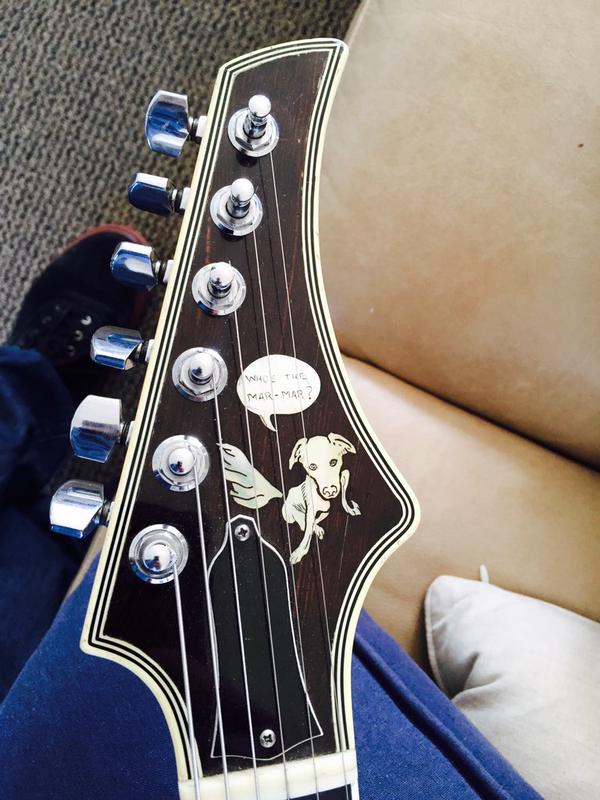
MarMar headstock — "Who's the Mar-Mar?" pearl inlay ↗
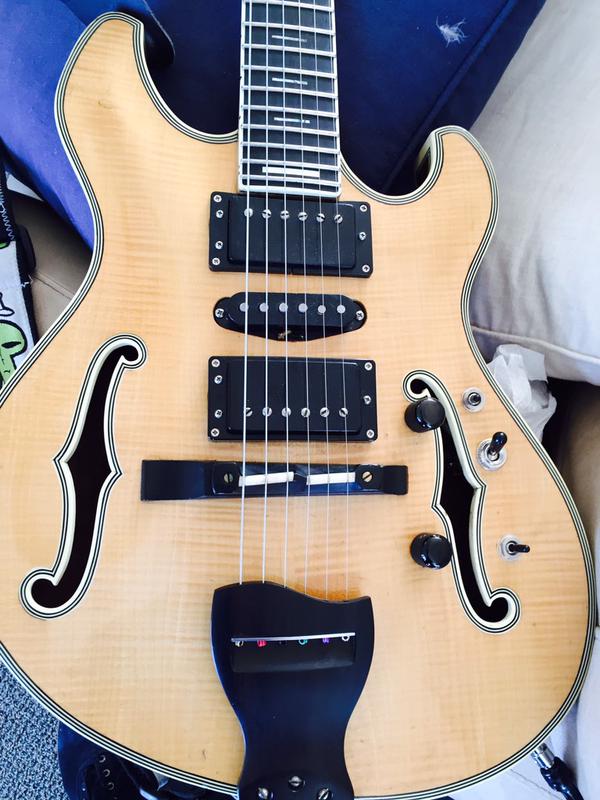
MarMar body — refitted with single coil pickup, some time in 2015 ↗
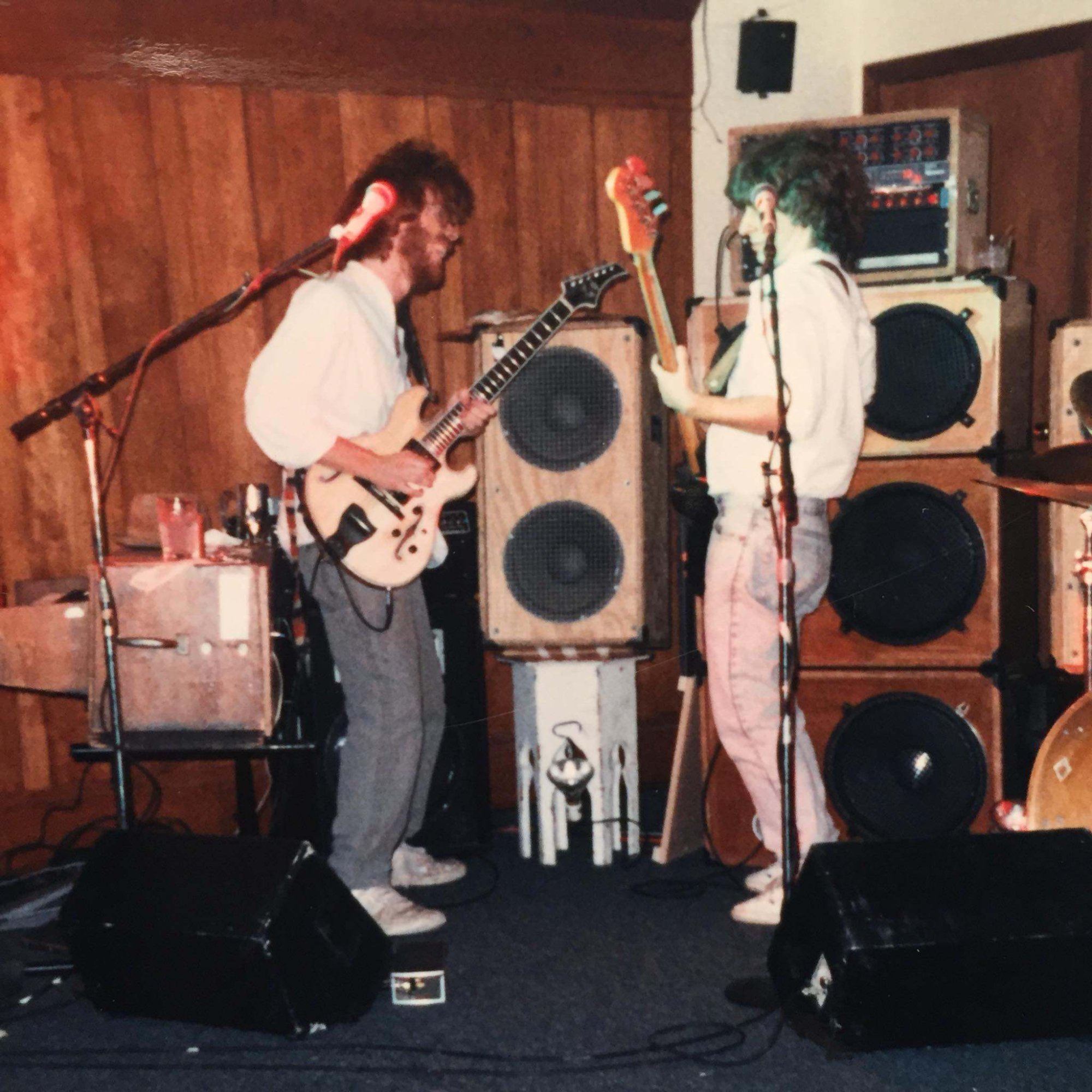
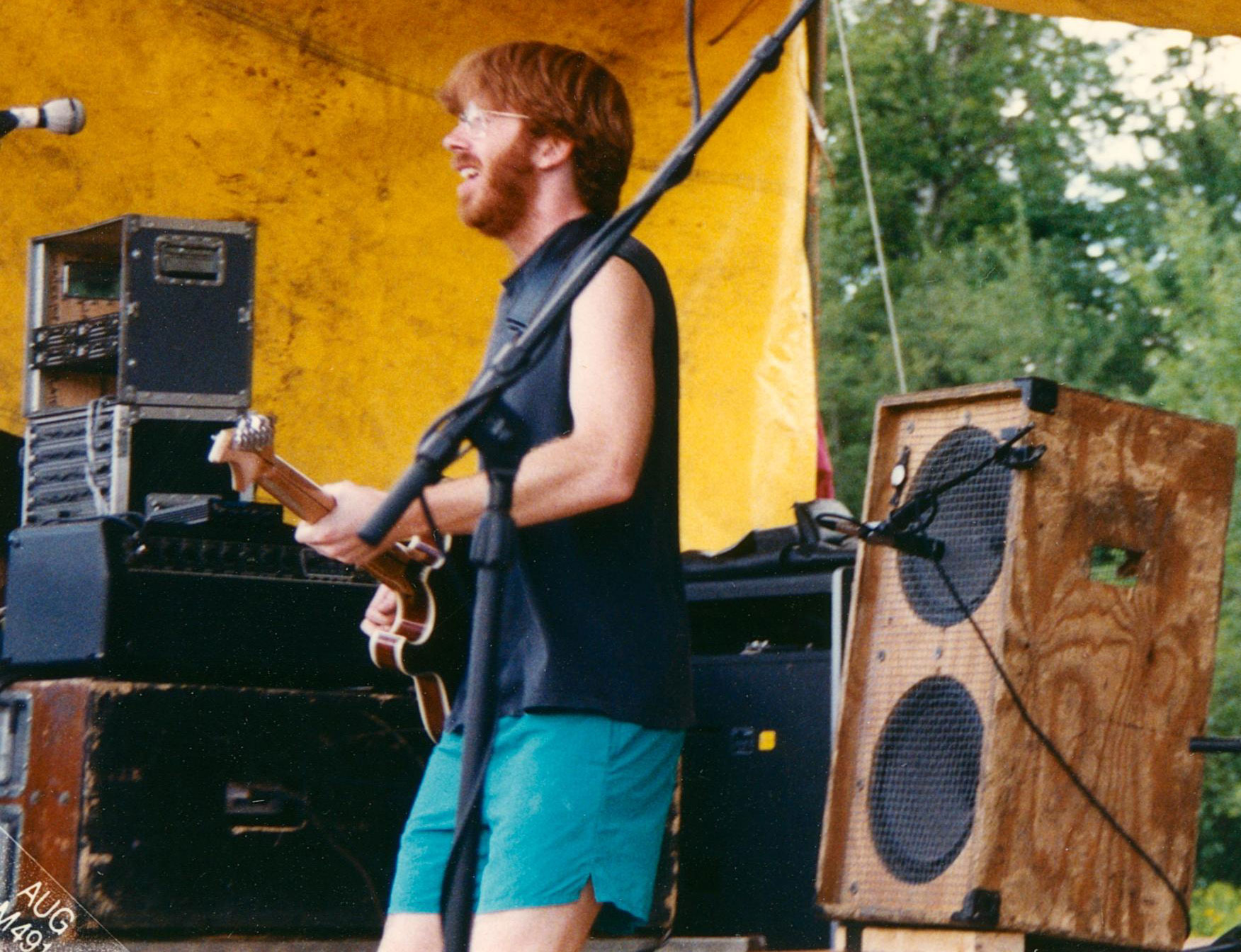
Colorado 1988 — MarMar, Ernie Ball volume pedal, Languedoc 2×12 cabinet ↗
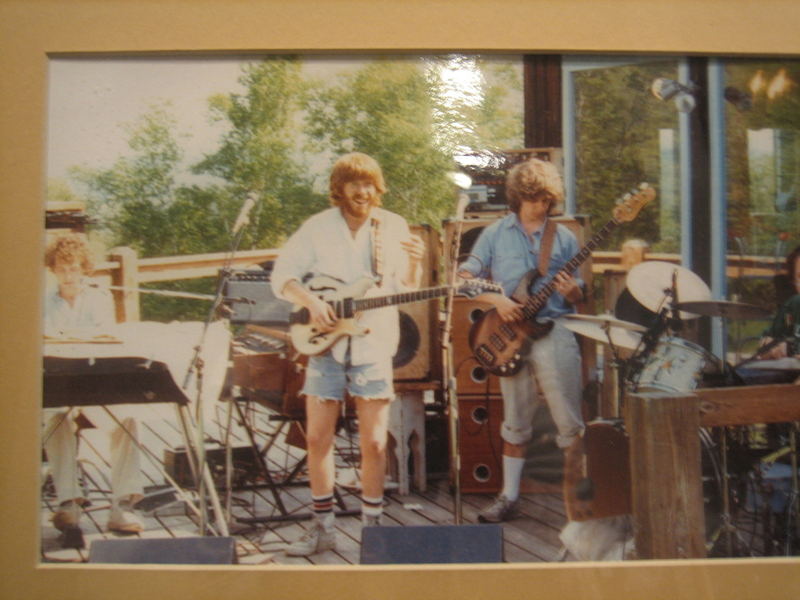
Late 1980s back porch — Phish as a wedding band, MarMar, Languedoc 2×12 cabinet ↗
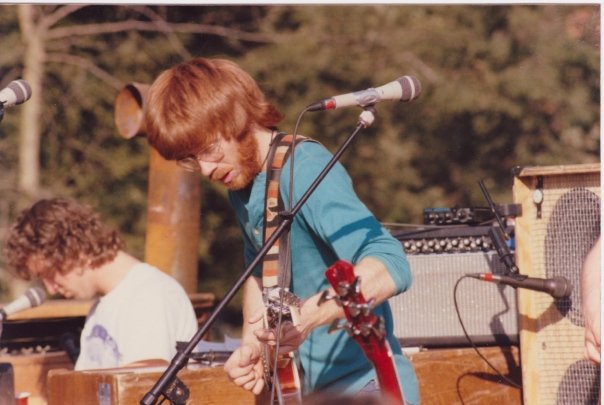
Late 1980s — outdoor show, MarMar, Microverb, Languedoc 2×12 cabinet, amp head unknown ↗
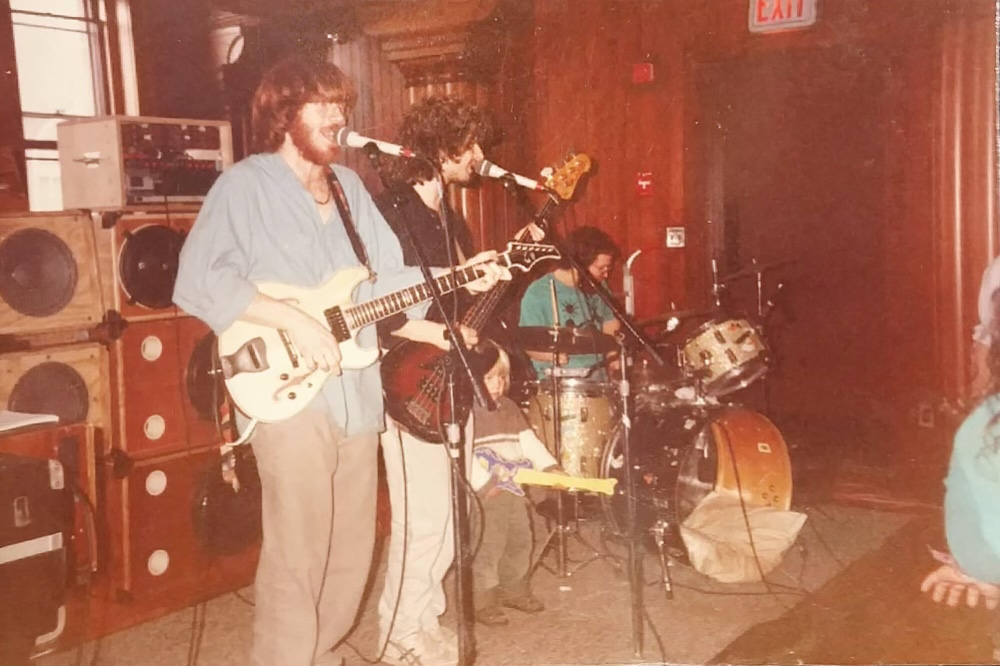
Late 1980s, UVM/Vermont club — early MarMar, stacked Languedoc plywood cabinets ↗
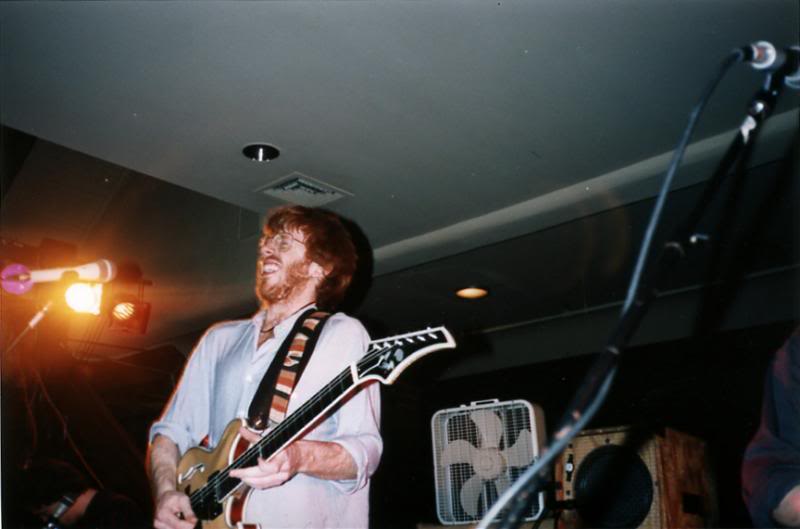
April 1989 Old Stone Church — MarMar, Languedoc 2×12 cabinet visible at right ↗
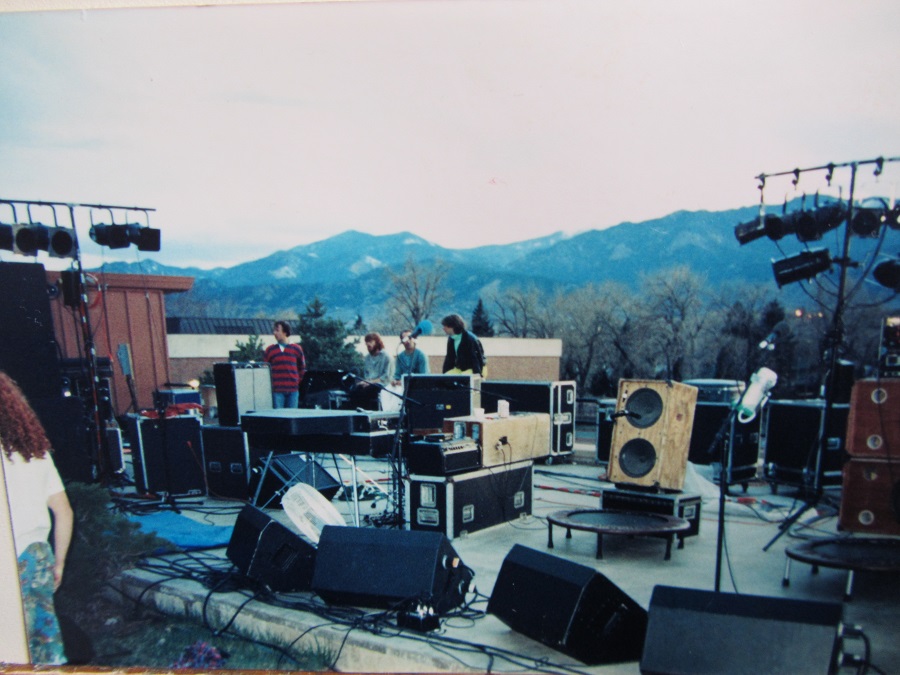
April 1990 Colorado College — Mesa Boogie Mark III on Page's organ, single Languedoc 2×12 cabinet ↗
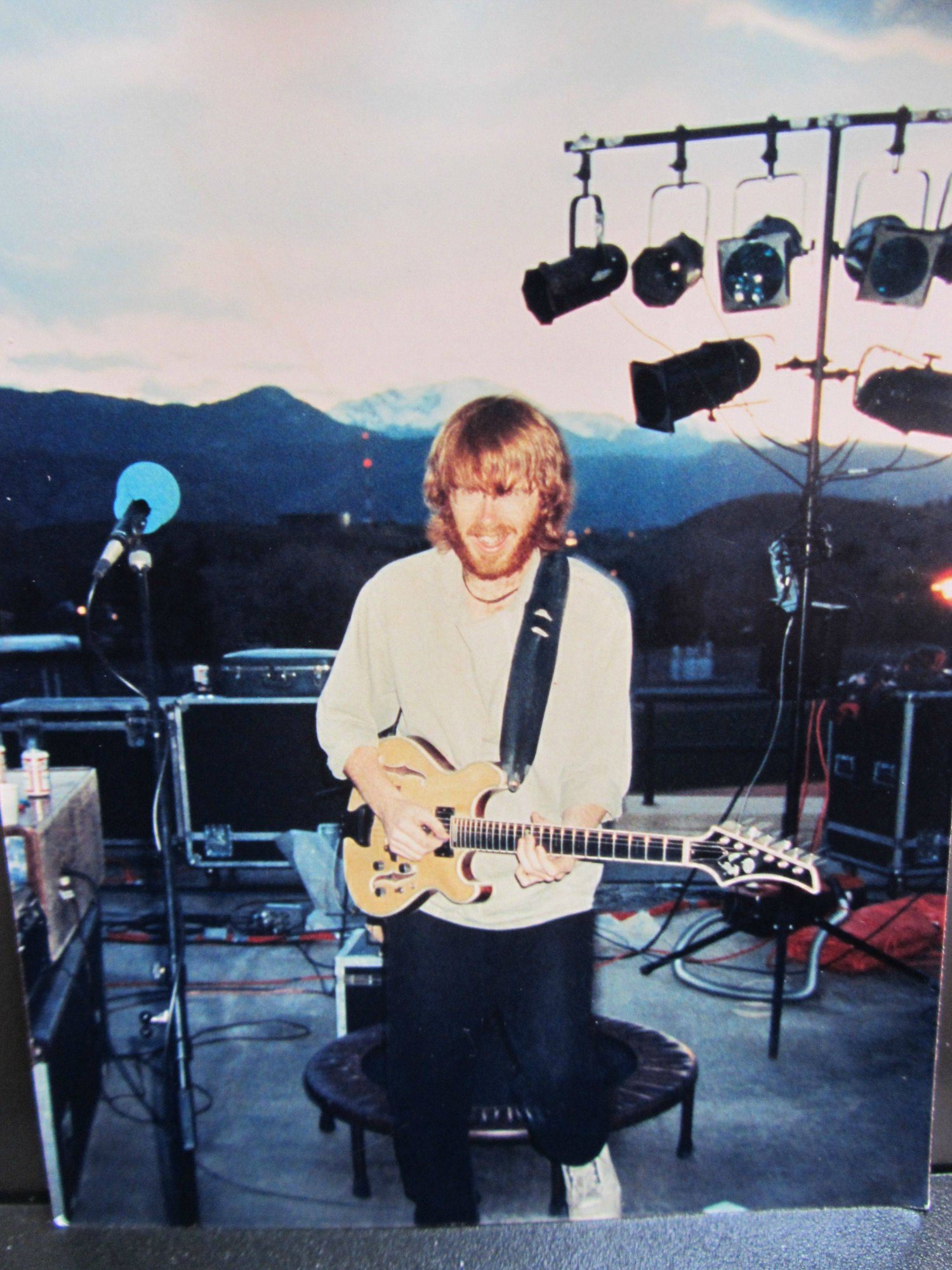
April 1990 Colorado College — Trey with the MarMar guitar ↗
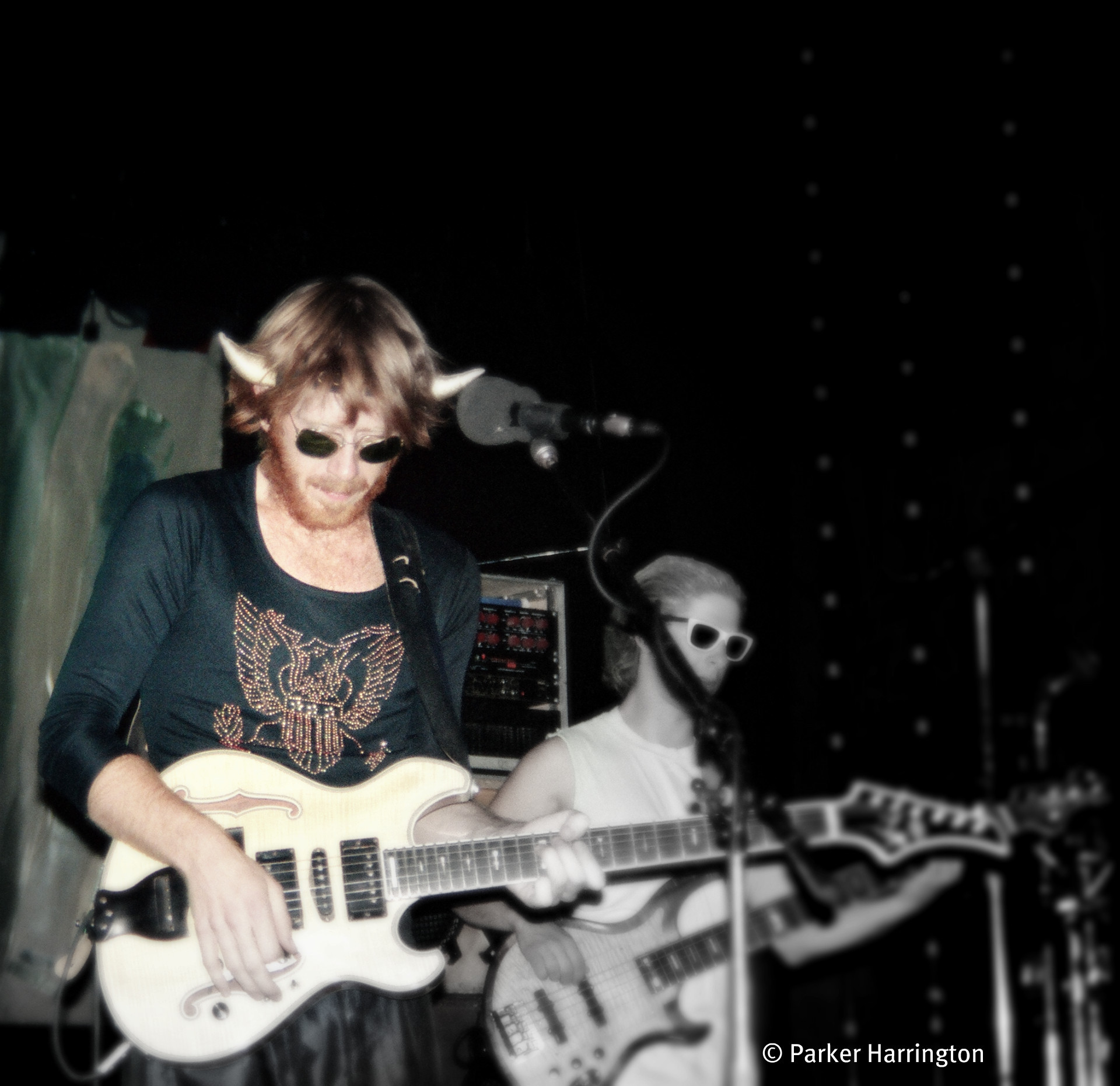
Halloween 1990 © Parker Harrington — MarMar, single-coil pickup visible ↗
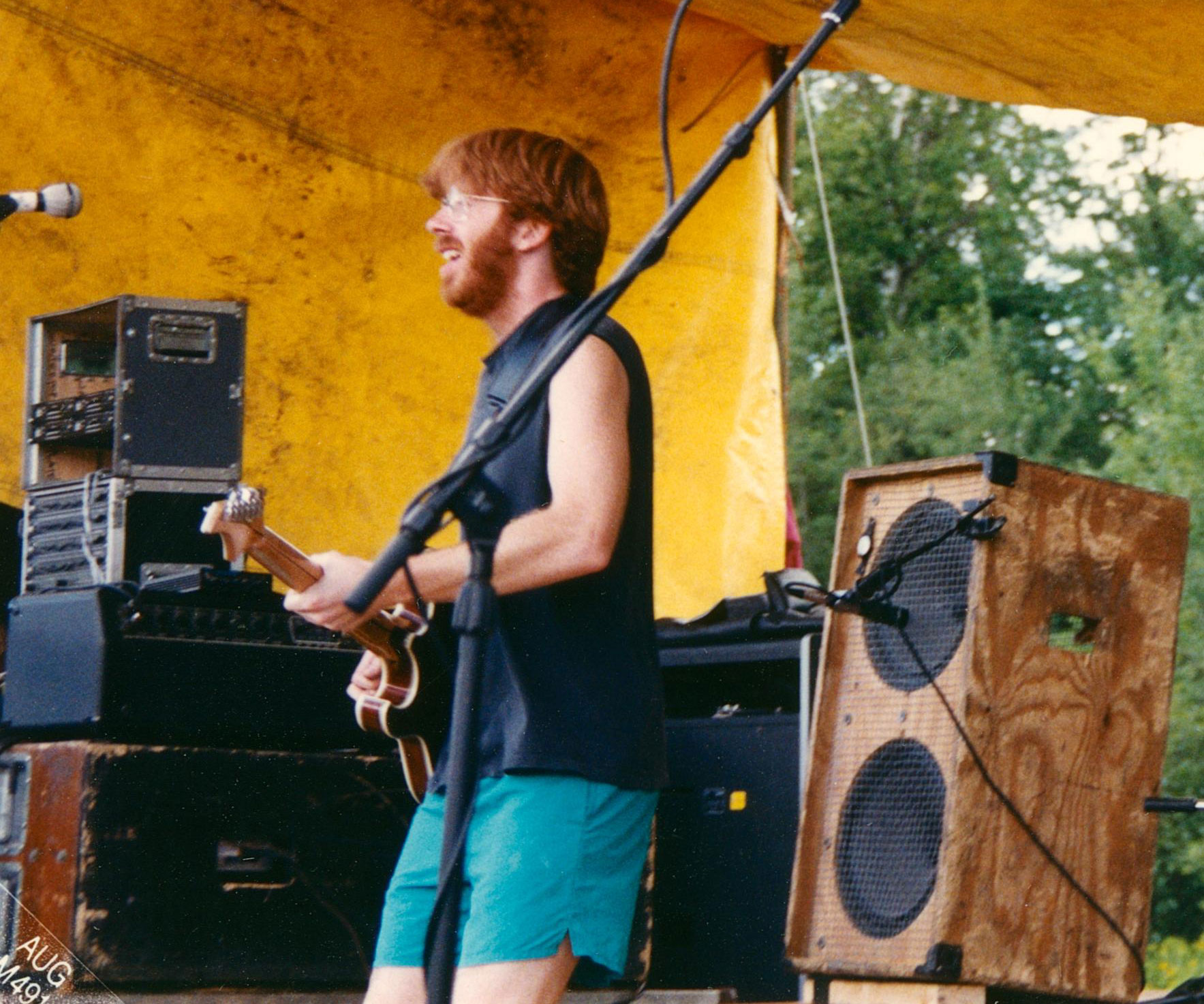
Aug 1991 Amy's Farm — Mesa Boogie with Microverb on top, MarMar, Languedoc 2×12 cabinet ↗
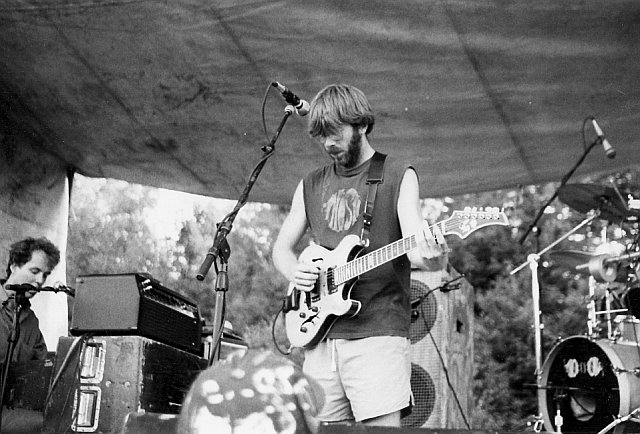
Aug 1991 Amy's Farm — Mesa Boogie Mark III on top of Page's organ, Languedoc 2×12 cabinet ↗
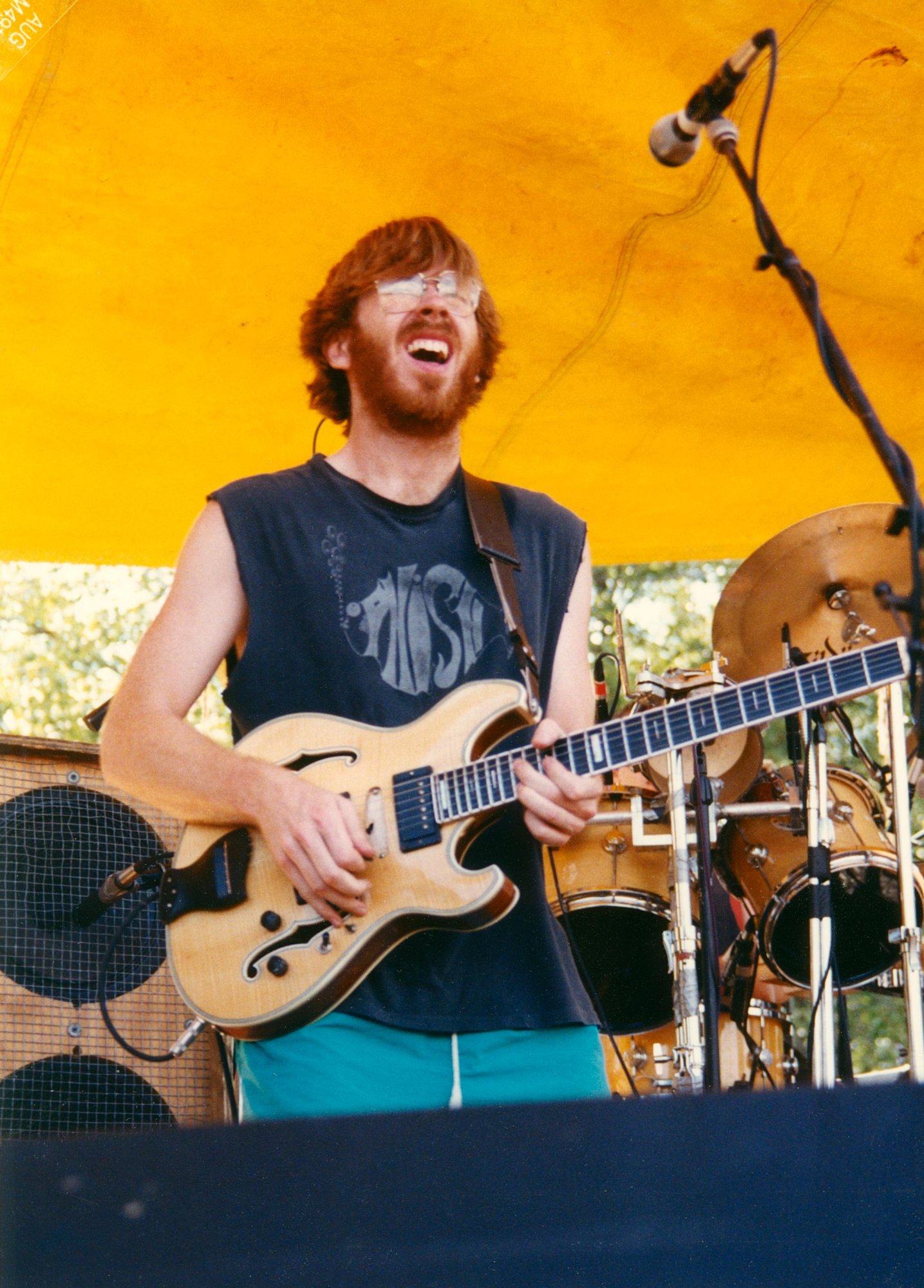
Aug 1991 Amy's Farm — MarMar, single pickup hole clearly visible, Languedoc 2×12 cabinet ↗
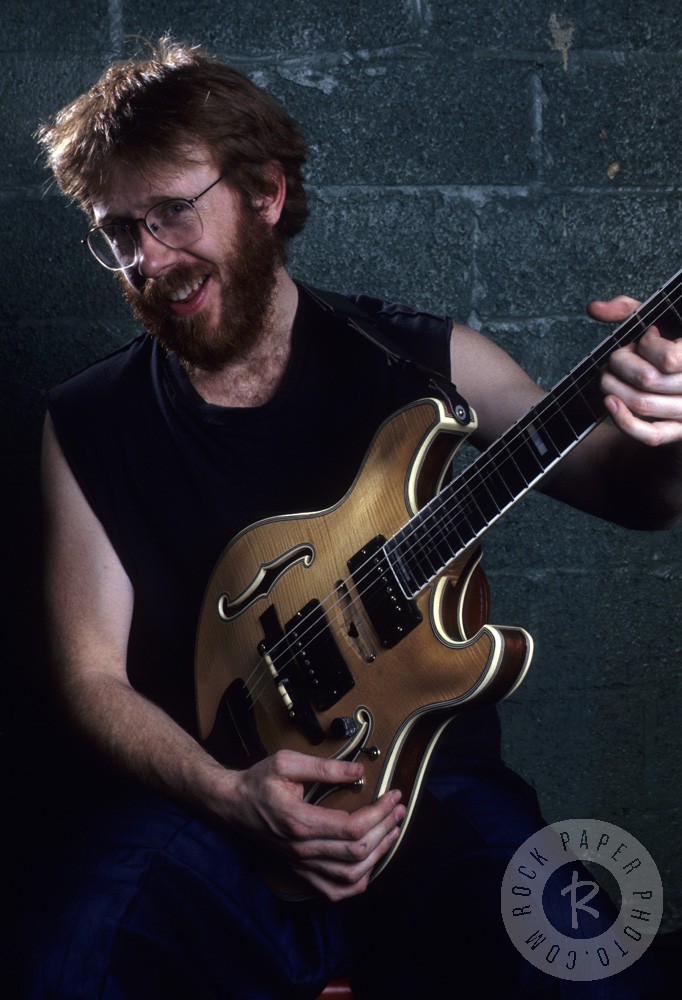
March 1992 Roseland Ballroom — MarMar, single pickup missing ↗
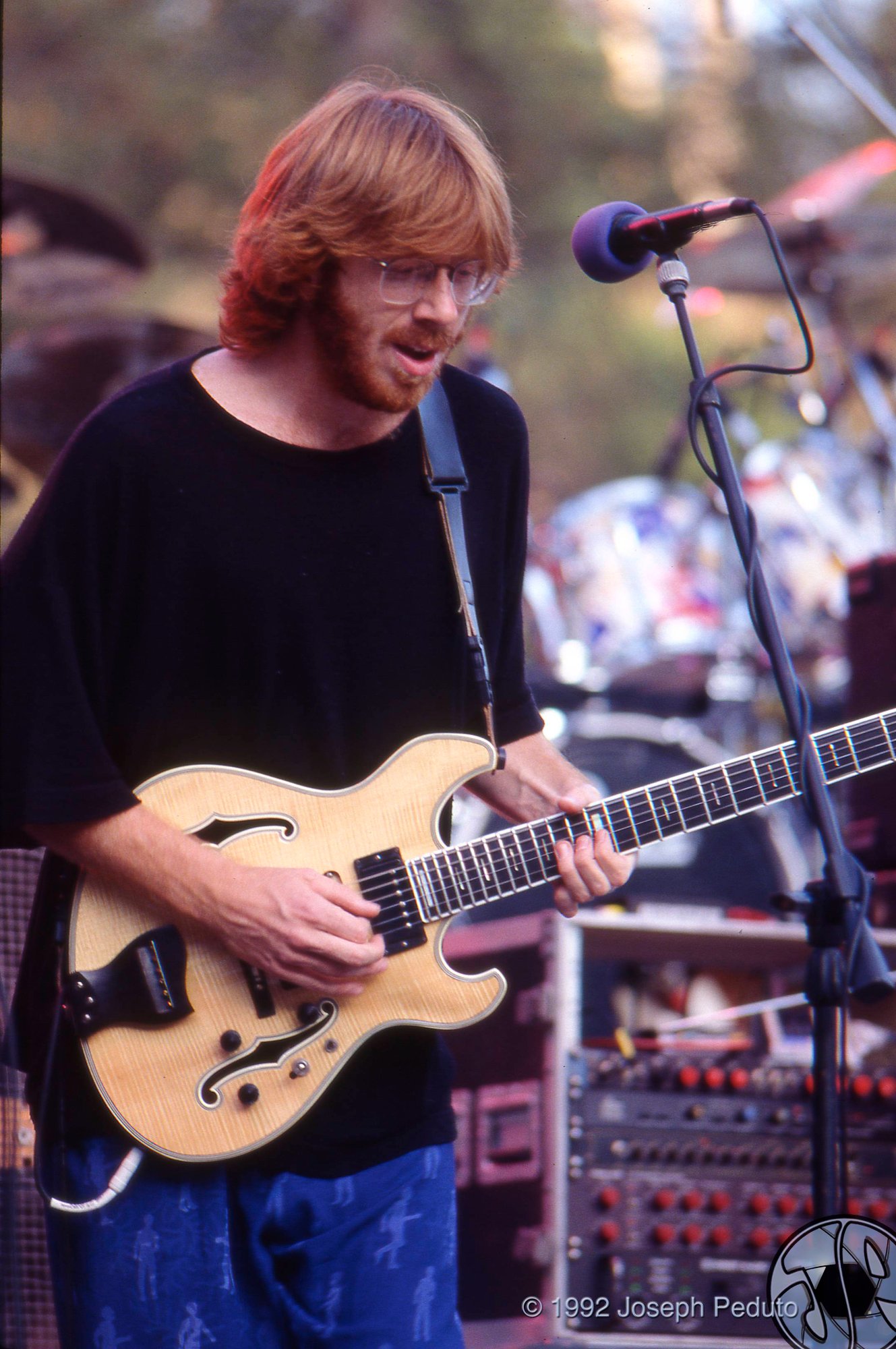
August 1992 with Santana © Joseph Peduto — MarMar, single-coil absent ↗
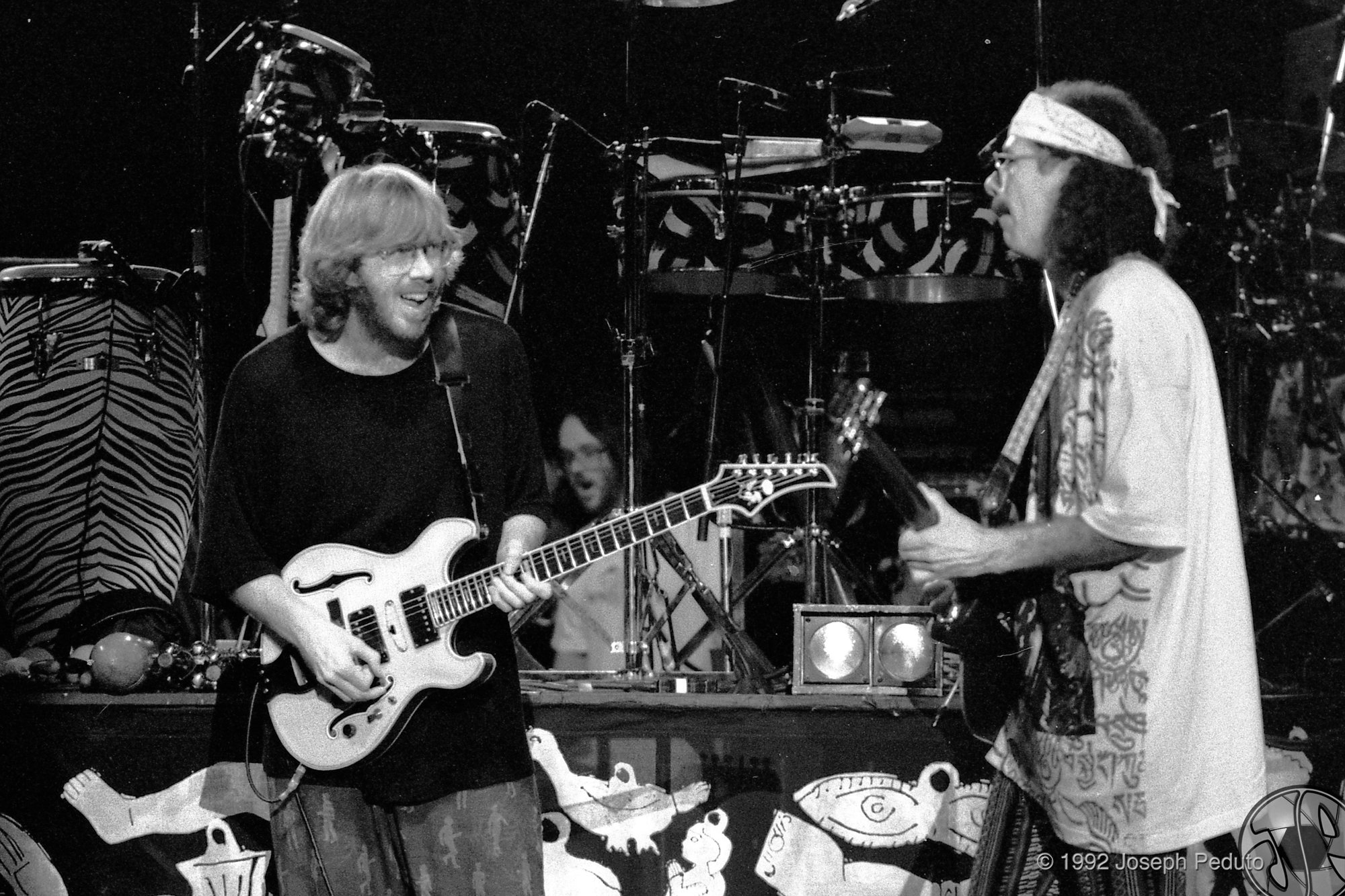
August 1992 with Santana © Joseph Peduto — MarMar, single-coil absent ↗
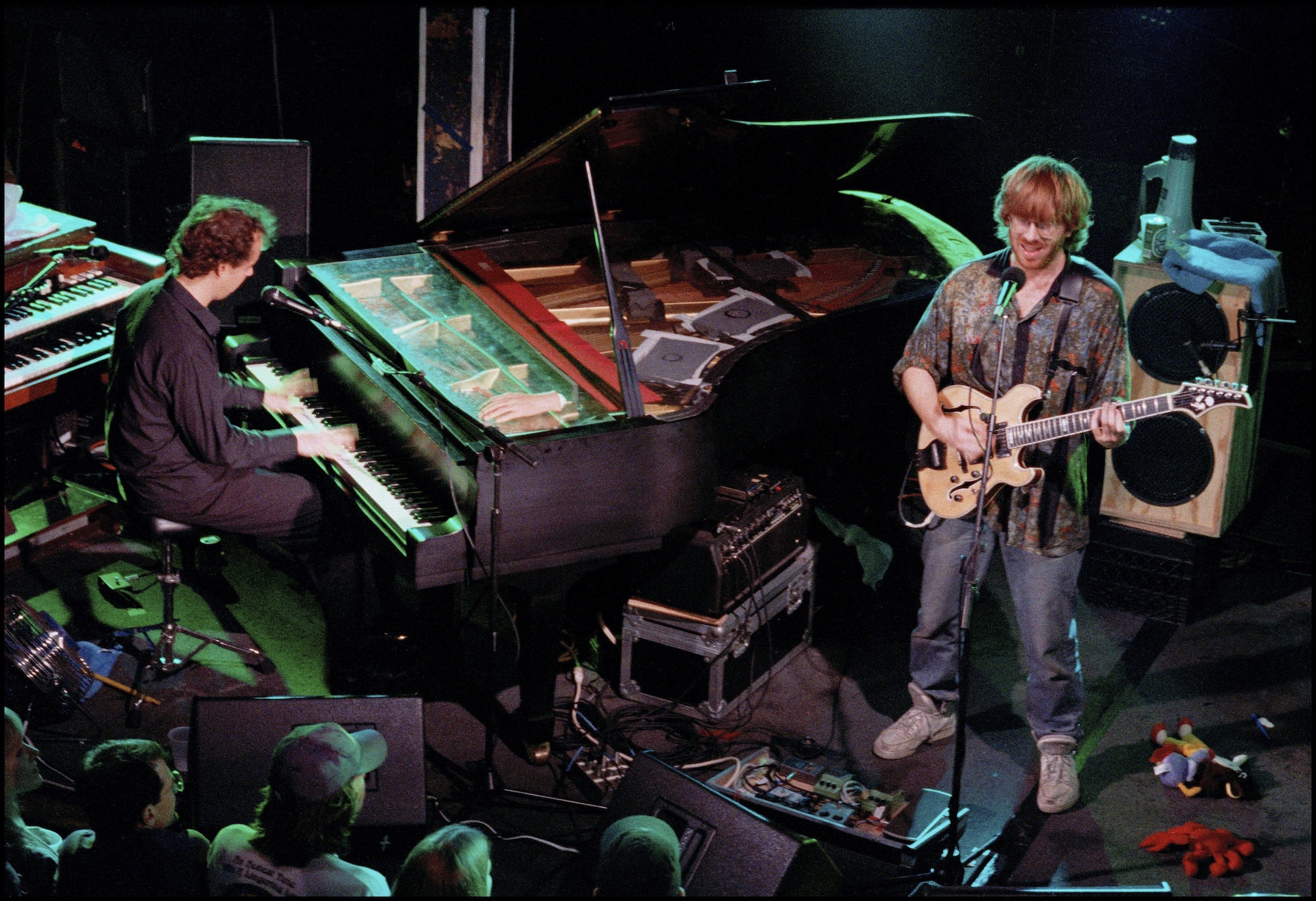
March 1993, Tipitina's — MarMar, pedalboard, Mesa Boogie Mark III + Microverb + rack tuner, Languedoc 2×12 on milk crate ↗
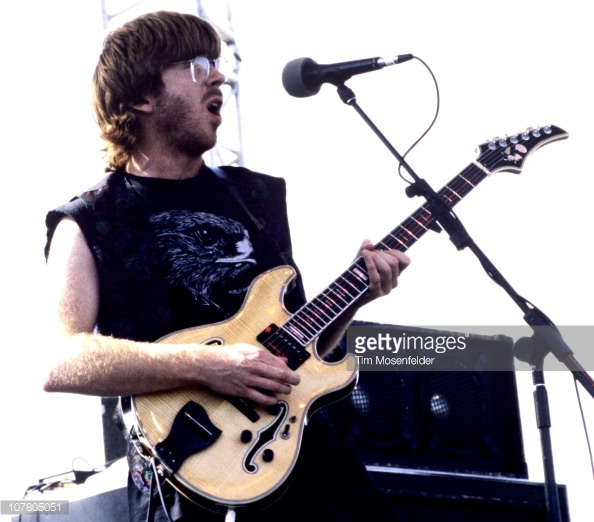
May 1993 — MarMar, single-coil absent © Tim Mosenfelder / Getty Images ↗
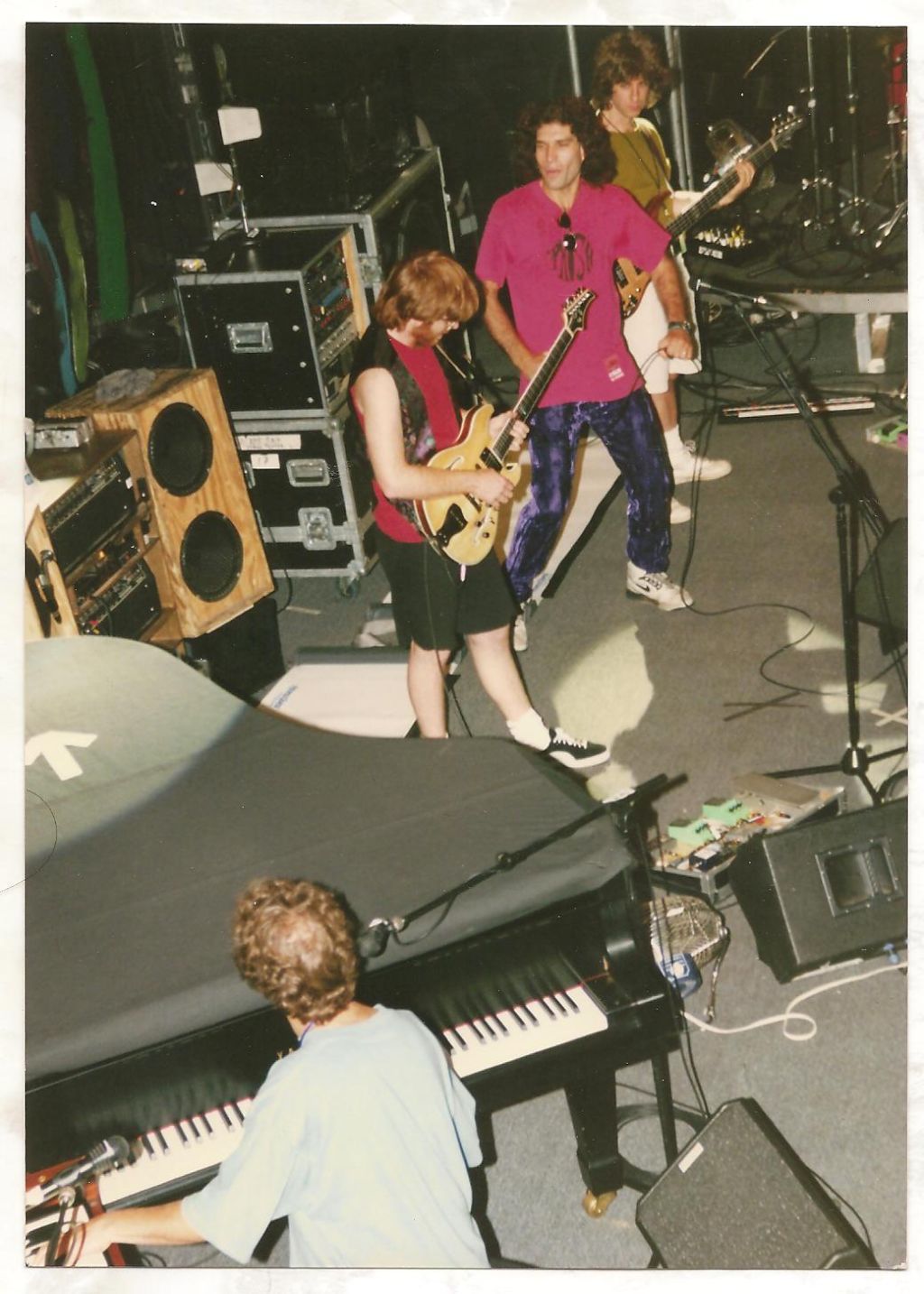
August 1993 — dual Languedoc 2×12 setup, dual Mesa Boogie heads, TS10s in pedalboard ↗
Click any thumbnail to open fullscreen slideshow.