Early–mid 1996
MarMar remains primary guitar · MTI Rotophaser in use
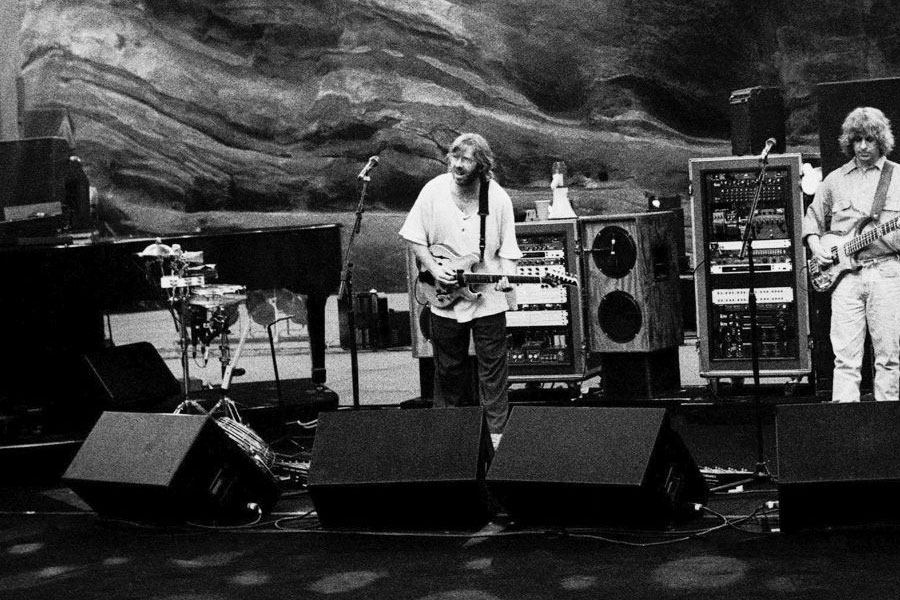
Trey opened the year with the same two-rack setup from 1995. The MarMar was his main guitar, the MTI Rotophaser handled Leslie duties.
1996 — date unconfirmed
Two racks consolidated into one
Rack A was retired. All effects, amplification, and reverb units moved into a single rack — Rack B's road case — simplifying the stage footprint considerably.
Through the Clifford Ball — August 16–17, 1996
MTI Rotophaser last confirmed in use
The Clifford Ball — Phish's first festival — represents the last confirmed appearance of the MTI Rotophaser in Trey's rig before it was replaced for the Fall tour.
Fall 1996
MTI Rotophaser replaced by Motion Sound Pro 3
For the Fall tour Trey switched to the Motion Sound Pro 3 Leslie unit — a more sophisticated rotating speaker system that would become a central part of his sound going forward.
October 25, 1996
Koa #1 debuts · MarMar retired for the year
Trey's third Languedoc hollowbody — a Koa wood instrument — made its confirmed live debut on 10/25/96, six nights before the landmark Halloween Remain in Light show in Atlanta. The MarMar was set aside for the remainder of the year.
Carried over from early October 1995
Small percussion kit continues
The small percussion kit that debuted in early October 1995 continued as part of Trey's stage setup through 1996.
Primary — early/mid year Carried over
Languedoc MarMar
The original Languedoc hollowbody — European curly maple top, padauk back and sides, mother-of-pearl Marley headstock inlay — remained Trey's main guitar through the majority of 1996 until the Koa #1 was ready. Full electronics and pickup configuration history is documented on the
1980s–1993 page.
New guitar — debut 10/25/96 New '96
Languedoc Koa #1 Hollowbody
Paul Languedoc's third custom hollowbody build for Trey, featuring a Koa wood body. An evolution of the first two instruments in construction and feel. Initially fitted with a tune-o-matic bridge; a custom brass saddle bridge was later installed, date unknown. The Koa #1 debuted on October 25, 1996 — just six days before Phish's landmark Halloween show at the Omni in Atlanta, where they performed Talking Heads' Remain in Light as their musical costume.
Alternate tuning — Fall 1996 From early '90s
Languedoc Spruce / "I'm the Mar Mar"
The 1991 Languedoc backup guitar — spruce top, maple body, with the "I'm the mar mar" adult Marley headstock inlay — was used on the Fall 1996 tour as a dedicated alternate tuning guitar for performances of "Waste." Rarely played in the early 1990s, it found a functional role here as a tuning-specific instrument. Its use can be seen on the official JEMP Records DVD release Coral Sky, which captures the complete 11/2/96 show at Coral Sky Amphitheater in West Palm Beach, FL — the only outdoor shed show of the Fall 1996 tour.
Koa #1 — bridge note
The Koa #1 was initially fitted with a tune-o-matic style bridge by Paul Languedoc. At some later point — date not yet confirmed — this was replaced with a custom brass saddle bridge. The exact timing of that modification is an open research question.
Halloween 1996 — Remain in Light
Phish's Halloween 1996 musical costume was Talking Heads' Remain in Light, performed at the Omni in Atlanta — one of the most celebrated shows in Phish history. The Koa #1 had debuted six nights earlier on 10/25/96, meaning Trey brought a brand new guitar into one of the highest-stakes performances of the band's career just days after first playing it on stage.
Las Vegas, 12/6/96 — Larry LaLonde plays the MarMar during Harpua
One of the most remarkable appearances the MarMar ever made came on the final night of the Fall 1996 tour at the Aladdin Theatre in Las Vegas. During an epic Harpua encore, Phish welcomed three guests on stage: Larry LaLonde and Les Claypool of Primus, and actor Courtney Gains — best known for playing Malachai in the 1984 horror film Children of the Corn. LaLonde played Trey's MarMar Languedoc hollowbody for the performance — a rare instance of another guitarist handling Trey's primary instrument mid-show — making it one of the most celebrated and bizarre encores in Phish history.
-
Song
"Talk" (from Phish's 1996 studio album Billy Breathes) was performed with Trey on acoustic guitar at multiple Fall 1996 shows. This is the primary confirmed acoustic guitar appearance of the year.
-
Nov 9, 1996
The Palace of Auburn Hills, MI — Talk featured Trey on acoustic guitar.
-
Nov 14, 1996
Hilton Coliseum, Ames, IA — Talk featured Trey on acoustic guitar.
-
Dec 30, 1996
FleetCenter, Boston — Talk featured Trey on acoustic guitar. New Year's Run show.
Note on Red Rocks (8/5/96) and Deer Creek (8/13/96)
Neither of these Summer 1996 shows has confirmed acoustic guitar notes in the Phish.net setlist data — consistent with the MTI Rotophaser still being in use at the time and no acoustic segments documented for those dates.
Preamp Unchanged
Custom Audio Electronics SE 3+
Carried over from 1995. Now housed in the single consolidated rack alongside all effects and reverb units. Trey confirmed in Guitar Shop (August 1996) that the preamp was loaded with old stock RCA tubes sourced by tech Steve Dikun: "I'm using this Bradshaw, 3-channel preamp now, and even that has old RCA tubes."
Power Amp Unchanged
Groove Tubes Dual 75
Carried over from 1995. The Guitar Shop (August 1996) rig diagram confirms the Dual 75 ran three speaker outputs simultaneously — left Languedoc 2×12, right Languedoc 2×12, and the MTI Rotophaser (early 1996 through Clifford Ball). Like the CAE SE 3+, it was loaded with old new-in-the-box vintage tubes sourced by tech Steve Dikun rather than new production stock. "Steve Dikun collects old tubes, new-in-the-box, and he loads up the amps, and my preamp, with those."
Speaker Cabinets ×2 Unchanged
Custom Languedoc 2×12 ×2
Both Languedoc-built plywood cabinets continued in use, both loaded with Celestion Vintage 30s.
The two separate racks from 1994–1995 were consolidated into a single unit in 1996. Everything that had previously lived across Rack A and Rack B now lived together. The rack is divided below by function for clarity, but all units shared one road case. Guitar Shop (August 1996) describes this consolidated layout in detail, with rack photographs taken at Bearsville Studios in Spring 1996 during the Billy Breathes recording sessions. The article confirms four CAE 4×4 Audio Controllers total, a Peavey Valverb tube Spring reverb as a fourth reverb unit alongside the three Alesis MicroVerbs, and a Roland MS-1 Digital Sampler in the effects chain.
The most significant mid-year change within the rack was the swap from the MTI Rotophaser to the Motion Sound Pro 3 Leslie for the Fall tour.
Amplification
1U
CAE SE 3+ Preamp
Preamp Carried
2U
Groove Tubes Dual 75
Power Amp Carried
Effects
1U
Korg ToneWorks DTR-2
Rack Tuner Carried
1U
Ibanez DM2000
Digital Delay Carried
1U
Ibanez TS-9
Overdrive Carried
1U
Ibanez TS-10
Overdrive Carried
1U
Ross Compressor
Always-on compressor Carried
1U
CAE Super Tremolo
Tremolo Carried
1U
CAE Black Cat Vibe
Univibe Carried
1U
MTI Rotophaser Through Clifford Ball
Rotary Replaced Fall '96
1U
Motion Sound Pro 3 Fall tour onwards
Leslie New Fall '96
4U
CAE 4×4 Audio Controller ×4
Loop Switcher Carried
1U
Roland MS-1 Digital Sampler Gone by Europe Summer '96
Sampler Removed mid-year
Reverb
1U
Alesis Microverb — "Reverse"
Reverb Carried
1U
Alesis Microverb — "Vast"
Reverb Carried
1U
Alesis Microverb — "Full"
Reverb Carried
1U
Peavey Valverb
Tube Spring Reverb Carried
MTI Rotophaser → Motion Sound Pro 3
The MTI Rotophaser was last confirmed in use at the Clifford Ball (August 16–17, 1996). For the Fall tour Trey switched to the Motion Sound Pro 3 — a more capable rotating speaker unit that would become a long-running fixture in his rig through 1997.
Pro 3 — self-contained treble amp, no external power needed
One of the most important differences between the Rotophaser and the Pro 3 was how each unit handled amplification. The MTI Rotophaser was a passive rotating speaker — it required an external amp to drive it, which is why the Groove Tubes Dual 75 power amp had a dedicated third speaker output wired to the Rotophaser throughout 1995 and into 1996.
The Motion Sound Pro 3 changed that equation. It is a hybrid unit: a real rotating treble horn driven by an Eminence compression driver and a built-in 30-watt solid-state amplifier that handles all frequencies above 700Hz internally — no external power amp required for the treble rotor. The Groove Tubes third output, previously tied up driving the Rotophaser, was freed when the Pro 3 came in. In Trey's rig the Pro 3 was used purely for the top-end chorale/organ effect, with all low-end handled as always by the Languedoc 2×12 cabinets.
Small percussion kit
The small percussion kit that debuted in early October 1995 continued as a fixture of Trey's stage setup through 1996. First confirmed on video at Seattle Center Arena on 10/3/95.
Same as 1995 — with Whammy II
The floor pedalboard continued from 1995 — CAE RS-10 MIDI controller, Ernie Ball volume pedal, Dunlop Crybaby wah, Whammy II, MTI Rotophaser control pedal (until Fall), and the CAE Super Tremolo rate pedal. The Rotophaser floor control was presumably retired when the unit was swapped for the Motion Sound Pro 3 in the Fall.
Performance Accessory Carried
Fanon MV-10S Megaphone
Video evidence from 1996 confirms the megaphone in use is a Fanon MV-10S — the same handheld unit identifiable from 1994 photo evidence. Carried through the year for performances of Fee.
Simplified signal flow — exact internal order not fully confirmed
→
→
→
→
→
→
→
→
→
→
→
→
Cabinets ×2
Languedoc
2×12 ×2
All rack units now in a single consolidated rack · Highlighted border = changed in 1996 · Dashed = effects loop
Leslie node shows MTI Rotophaser (through Clifford Ball, Aug. 1996) replaced by Motion Sound Pro 3 (Fall 1996 onwards). Exact internal signal order not fully confirmed.
1996 was a year of consolidation and transition. The most visible structural change was the collapse of two racks into one — a simplification that made sense as the rig matured and its contents became more settled. With the core amp system and effects now well established, there was less need for the sprawling dual-rack architecture that had developed through 1994–1995.
The mid-year Leslie swap was significant. The MTI Rotophaser — Trey's first rotating speaker unit, in the rig since 1995 — gave way to the Motion Sound Pro 3 for the Fall tour. The Pro 3 was a more fully realized Leslie simulation and would become a fixture going forward.
The other major story of 1996 was the arrival of the Koa #1. Paul Languedoc's third hollowbody build for Trey debuted before the legendary Halloween Remain in Light performance in Atlanta — one of the most celebrated shows in Phish history. The Koa #1 would go on to be Trey's primary instrument for years. Its initial tune-o-matic bridge was eventually replaced with a custom brass saddle, though the timing of that modification remains unconfirmed.
Single Rack
Motion Sound Pro 3
Koa #1
DM2000
Whammy II
CAE SE 3+
Groove Tubes Dual 75
MarMar
Languedoc 2×12 ×2
Clifford Ball
Halloween — Remain in Light
1996 is well-documented on LivePhish. Deer Creek 8/13/96 (Live Phish Vol. 12) is the canonical Summer release — the consolidation of Trey's rack into one unit captured at its finest. The Halloween Remain in Light show (Vol. 15) is essential for any Koa #1 documentation — the guitar's debut came just days before this show.
Research needed
The following items represent open questions for this era — areas where documentation is incomplete or evidence is not yet confirmed.
-
Acoustic guitar — make/model
The specific acoustic guitar used for "Talk" (from Billy Breathes) at Auburn Hills (11/9/96), Ames (11/14/96), and FleetCenter (12/30/96) has not been confirmed. Make, model, and year of the instrument are unknown.
-
Rack consolidation — exact date
The precise show or tour leg at which Trey's two-rack setup was consolidated into a single rack in 1996 has not been confirmed. It is placed sometime in 1996 based on available evidence.
-
Koa #1 — brass bridge modification date
The Koa #1 debuted with a tune-o-matic style bridge. At some later point a custom brass saddle bridge was installed by Paul Languedoc, but the exact date of that modification is not confirmed.
-
Small percussion kit — exact configuration
The kit debuted in early October 1995 (first confirmed on video at Seattle Center Arena, 10/3/95) and continued through 1996. The specific instruments that made up the kit — what drums, percussion, or auxiliary pieces it comprised — have not been fully documented.
-
Peavey Valverb — exact role in live mix
The Peavey Valverb tube Spring reverb is confirmed in the rig by Guitar Shop (August 1996). How it was blended against the three digital Alesis MicroVerbs in Trey's live mix — whether it was used on all channels, selectively via the 4×4 routing, or for specific sounds — has not been documented from available sources.
-
Roland MS-1 — live use and removal date unconfirmed
The Roland MS-1 Digital Sampler is confidently in the rack by Fall 1995, visible in rack photographs taken at Bearsville Studios (Spring 1996, during the Billy Breathes sessions) and published in Guitar Shop (August 1996). Whether it was ever used live — and if so, how it was patched into the rig — has never been confirmed. Rack photographs from the Europe Summer 1996 tour show the unit is gone by that point, but the exact removal date is unknown. An open research question.
Trey with the Koa #1 — late 1996
The Koa #1 — Languedoc Build #3
Motion Sound Pro 3 Leslie unit
Consolidated single rack — 1996
Clifford Ball — August 1996
Halloween show — Atlanta, Remain in Light
MTI Rotophaser — last era of use
Small percussion kit on stage
Click any thumbnail to open fullscreen slideshow. Replace src values in the script below with real image URLs when ready.